
 Nov 4, 2026
 Geography
Business allocation for digital asset full-service work is decided in two cuts — by client identity and by revenue scale — and the four-module mix is then set by the client's dominant KPI. Includes full mix tables for factory, brand and growth clients, rollout cadence, and three hard rules.
60-second answer: business allocation for a digital asset full-service engagement comes down to slicing the client base two ways — first by identity (factory, brand or growth), then verifying against scale (annual revenue in the RMB 50–500 million range). Once that is settled, the mix across website, GEO, video and media is not split evenly by budget: it is decided by which KPI the client is actually buying. This article gives the full mix table for all three client types, the rollout cadence for each, and the three hard rules that cannot be broken.
Start with a common misconception. When companies discuss a full-service engagement, they often assume each of the four modules should take a quarter — “it looks fair, and the risk is spread evenly.” In practice this is the weakest possible allocation, because the four modules have completely different payback cycles: a website builds assets that keep working for more than 20 months, while a media placement typically has a three-month exposure window. Equal allocation buys four things that decay at very different speeds, for the same money.
Contents
· 1. Why split by client type rather than by tier
· 2. The two cut lines in the client profile
· 3. Factory-type: website and GEO take the largest share
· 4. Brand-type: media and video take the largest share
· 5. Growth-type: speed first, website and GEO in parallel
· 6. Putting all three client types on one timeline
· 7. The three hard rules of business allocation
· 8. Three questions we hear most
1. Why split by client type rather than by tier
The four engagement tiers — Starter, Growth, Flagship and Supreme — are segmented by the size of the commitment. They answer the question “how much goes in.” The module mix inside a tier answers a different question: “where does it go.” These two decisions have to be handled separately, because at the same tier level, a factory client and a brand client should be spending their money in completely different places. For the underlying module definitions, see our insights library.
Allocation, at its core, answers one question: what is actually blocking this client's growth — being found, being trusted, or ramping up too slowly? Each answer maps to a different mix.
The reason the mix cannot be even comes down to how each module behaves over time. The chart below plots the ramp-up phase and the effective window of all four modules on a single axis.
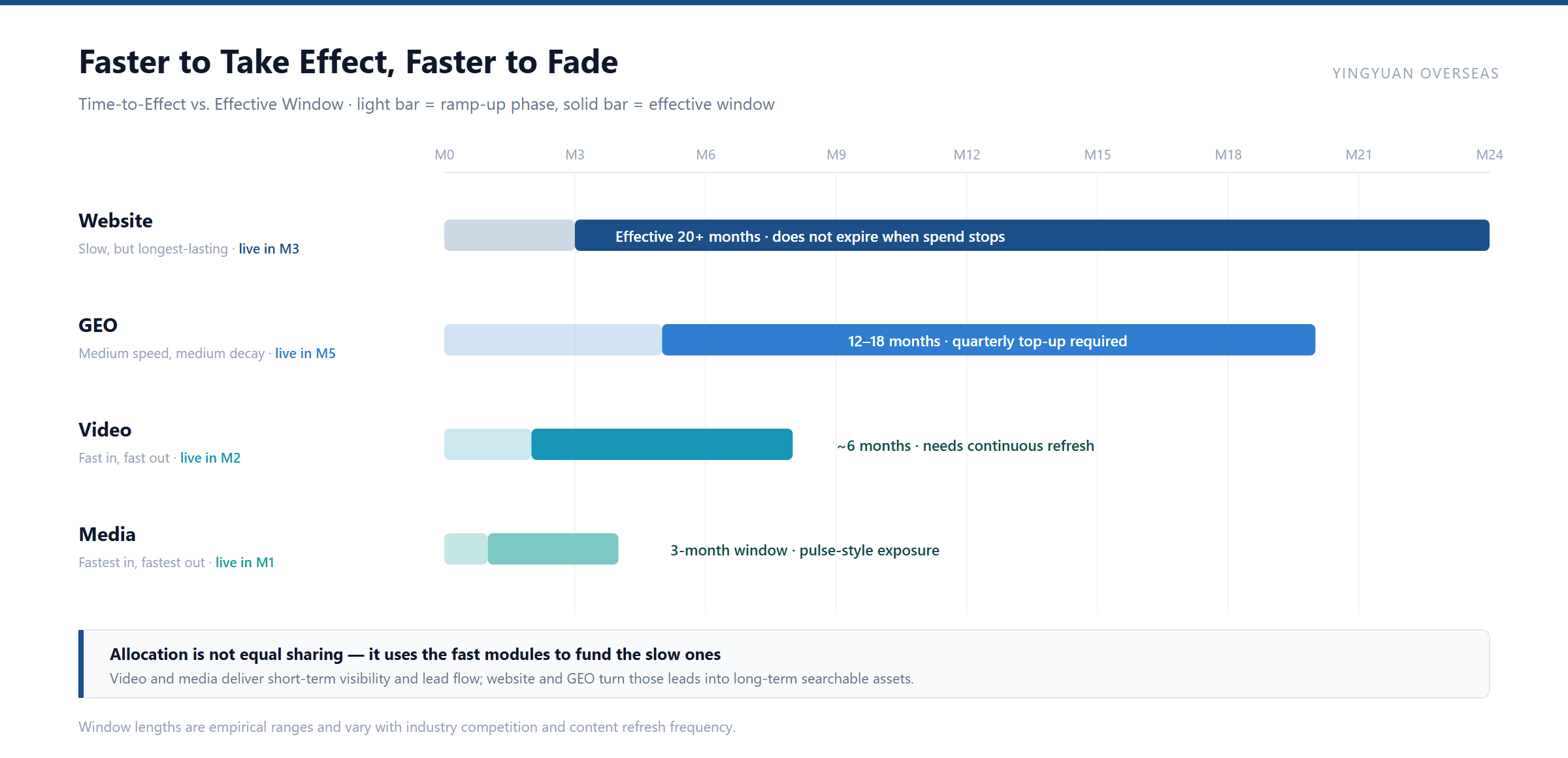
Ramp-up phase versus effective window for the four modules (light bar = ramp-up, solid bar = effective window)
Three conclusions follow. First, of the four modules the website has the longest asset life: once live in M3 it keeps working for more than 20 months, and it does not expire simply because investment stops. Second, GEO has a 12–18 month window and needs quarterly top-ups — it is a maintained asset, not a one-off build. Third, video and media have windows of roughly six months and three months respectively, which makes them pulse-style investments by nature.
That is exactly what allocation means here: not equal sharing, but using the fast modules to sustain the slow ones. Video and media deliver short-term visibility and lead flow; website and GEO convert those leads into long-term searchable assets.
Note: window lengths are empirical ranges that vary with industry competition and content refresh frequency. They are indicative, not a performance guarantee.
2. The two cut lines in the client profile
Every full-service client is classified along two hard cut lines: the identity line determines the mix structure, and the scale line determines whether the client belongs in the full-service pool at all. Neither is a matter of opinion — both have verifiable evidence behind them.
Identity line: decision-maker and core concern by client type
| Client type | Decision-maker | Core concerns |
| Factory-type | Owner / export manager | Inquiry conversion, search rankings, ownership of the site and its source code |
| Brand-type | Brand director / CMO | Brand tone, authority-media endorsement, owned-audience building |
| Growth-type | Startup CEO | Speed of launch, cost control, room to scale |
Scale line: does the client qualify for full-service
· Mid-market companies with annual revenue in the RMB 50–500 million range
· Multiple business lines, multiple acquisition channels and multilingual requirements running in parallel
· A budget that clears the full-service threshold — companies below it are better served by a single module than by a four-module framework with nothing inside it
Crossing the two lines produces nine theoretical segments, but signed clients cluster heavily in three: factory-type at RMB 100–300 million revenue, brand-type at RMB 100–300 million, and growth-type at RMB 50–100 million. The other combinations are not impossible — they simply need more upfront work to confirm the mix.
In practice there is a faster test. At the M1 strategy session, ask three questions face to face: does the owner personally read the backend data? Will the brand lead join the monthly strategy meeting? Does the CEO hold the team to quantified ROI targets? The answers usually point to the path — the first two skew toward factory or brand, the third toward growth.
3. Factory-type: website and GEO take the largest share
The typical client is a manufacturing plant or industrial-goods business with annual revenue of RMB 100–300 million. The owner signs off, an export manager handles day-to-day contact, and the core KPIs are inquiry volume, search rankings and ownership of the site and its source code.
| Module | Recommended weight | Priority | Rollout |
| Website | 40% | P0 | Starts in M1–M2 |
| GEO | 35% | P0 | Starts in M2–M3 |
| Video | 15% | P1 | Starts in M4 |
| Media | 10% | P2 | Starts in M9 |
The reasoning is direct: the core KPI is inquiry conversion, so the marketing-oriented website (which hosts the inquiry form) and GEO work (which determines whether AI search cites the company at all) have to take the largest share. Video and media are supporting instruments at this stage. The 40 / 35 / 15 / 10 structure reflects the median range across the factory clients we have served, not the outcome of a single case.
Four notes on rollout cadence
· Prioritise a marketing site over a brochure site. Delivery runs about 20–35 working days; solve “can it capture an inquiry” before discussing visual polish.
· Start GEO on two platforms — Doubao and DeepSeek — then expand to four or five as budget allows, rather than spreading thin from day one.
· Video starts in M4 because in the first three months the site and its content have not accumulated enough for video assets to sit on; spend converts poorly without that foundation.
· Media starts in M9 because authority endorsement is a nice-to-have for factory clients rather than an urgent need. Once inquiry data stabilises around M9, concentrated placements move conversion more noticeably.
4. Brand-type: media and video take the largest share
The typical client is a consumer brand or a leading B2B company with annual revenue of RMB 100–300 million. The brand director or CMO decides, and the core KPIs are brand tone, authority-media endorsement and owned-audience building.
| Module | Recommended weight | Priority | Rollout |
| Media | 40% | P0 | Starts in M1 |
| Video | 30% | P0 | Starts in M1 |
| Website | 20% | P1 | Starts in M3 |
| GEO | 10% | P1 | Starts in M5 |
This mix is nearly the mirror image of the factory one: factory clients have GEO in place by M2–M3, while brand clients do not start GEO until M5. That is not because GEO is ineffective for brands, but because a brand's core audience is not reached primarily through search. Brand awareness depends far more on media citation and video tone. Pushing budget into GEO too early is a poor trade.
Four notes on rollout cadence
· Media must start in M1. Brand-upgrade windows — pre-fundraising, a going-global communications push, a product launch — usually cannot be postponed, and missing one means waiting another year.
· Video starts alongside media because brand clients need assets ready for every placement: one short video can be distributed to the corporate site, the WeChat Channels account and the Douyin account at the same time.
· The website upgrades to a custom build, delivered in roughly 45–90 working days, so it can absorb the referring authority that media placements generate.
· GEO starts in M5, by which point brand-side content has accumulated enough material to be citable by AI systems — launching earlier wastes budget on thin content.
5. Growth-type: speed first, website and GEO in parallel
The typical client is a fast-growing company with annual revenue of RMB 50–100 million. The CEO decides, and the core KPIs are speed of launch, cost control and room to scale.
| Module | Recommended weight | Priority | Rollout |
| Website | 35% | P0 | Starts in M1 |
| GEO | 35% | P0 | Starts in M1 |
| Video | 20% | P1 | Starts in M3 |
| Media | 10% | P2 | Starts in M9 |
For growth clients the core KPI is one word: fast. Speed of launch and speed of GEO coverage have to take the largest share. Media sits at the back because at this stage the company is building volume quickly, not buying authority.
Four notes on rollout cadence
· The website launches in M1 and should stay within 25 working days. Slower than that and the leadership team tends to lose patience by the second sprint.
· GEO starts on two platforms, Doubao and DeepSeek. Four platforms in M1 is not advisable — it is expensive and produces unflattering ROI figures before there is content to support it.
· Video starts in M3, once website and GEO copy already exists, so video assets can be produced as a second pass over proven material rather than from scratch.
· Media starts in M9, when growth clients are typically pushing through the RMB 100 million revenue threshold and concentrated placements have the clearest leverage on valuation and fundraising. See our competitor analysis for how these timelines compare across the market.
One observation: of the three types, growth clients feel the effect of an M1 launch most directly — a one-month delay is immediately experienced as “traffic hasn't taken off.” That is also why this group renews at a relatively high rate in year one.
6. Putting all three client types on one timeline
Separately, the weights are easy to remember. Together, the differences become visible. The chart below places the module start points for all three client types on one Gantt-style axis: the horizontal axis is the project month, each dot is a module start, the light bar to its left is the time that module has already been running, and the number is the module weight.
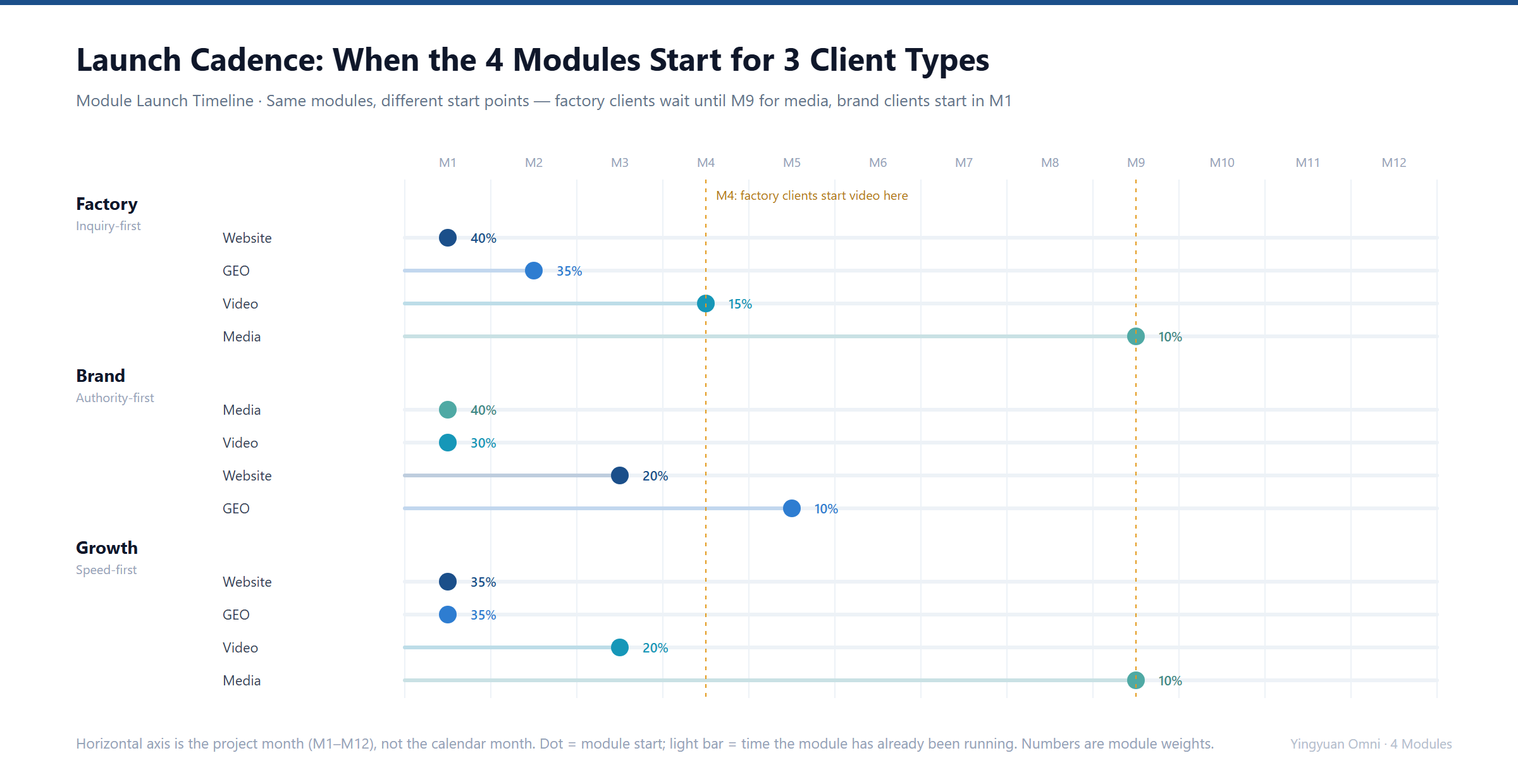
Module start points and weights across the three client types (horizontal axis: project month M1–M12)
Three differences stand out:
· Factory is front-loaded on the two modules that produce inquiries: website and GEO are in place by M1–M3, video waits until M4 and media until M9.
· Brand is authority-first: media and video start together in M1, the website moves to M3 and GEO to M5. Budget goes into building recognition.
· Growth runs the two site-side modules in parallel: website and GEO both start in M1, with video in M3 and media in M9. The goal is to get “being found” working in the shortest possible time.
In short, the order in which modules start often shapes how the client experiences progress more than the weights do. The weights decide where the money goes; the sequence decides in which month the client first feels that something is working.
7. The three hard rules of business allocation
The mix can flex. The three rules below cannot — break any one of them and allocation degrades into splitting a budget by gut feel.
Rule 1: hard budget cut
Clients whose budget falls below the full-service threshold do not enter the full-service pool; they should be routed to a single module — a standalone website build, or GEO on its own. Forcing a four-module engagement on that budget means nothing gets done properly, which is worse than doing one thing completely.
Rule 2: hard identity match
The identity line is fixed at the M1 strategy session on the spot, and is not re-opened after M3. The reason is practical: changing identity changes the mix, and the first three months of content and data were built against the original weighting — switching means starting over.
Rule 3: hard scale verification
Annual revenue figures need to be backed by an audit report or tax filing materials. Verbal numbers are not accepted. It sounds strict, but scale is what the whole budget structure rests on — get it wrong and every downstream number is wrong too.
8. Three questions we hear most
Q1. We fit both the factory and the brand profile — how do you classify us?
Classify by the dominant KPI. If the owner cares most about inquiries, it is factory-type; if the brand lead cares most about authority endorsement, it is brand-type. We do not accept an equal-weight, four-module plan — an even split means there is no primary direction.
Q2. Once the allocation is set, can it be adjusted midway?
Yes, but only within the M1–M3 adjustment window. After M3 we do not re-weight, because once the four modules are working together, changing the mix wastes the content and data accumulated in the first three months.
Q3. Our revenue exceeds RMB 500 million — does full-service still apply?
Yes, but it moves to the Supreme tier with a dedicated engagement. The standard full-service SOP is built for the RMB 50–500 million range; beyond that, companies usually run multiple business units or sub-brands and need a mix set per unit rather than for the group as a whole.
Final thoughts
Business allocation is not a consulting talking point — it is a concrete output of the M1 strategy session. The question it answers is simple: where is growth actually blocked, and therefore where should the money go first. This piece is part of our Geography coverage of how B2B go-to-market patterns differ by region and client type.
If you are weighing depth in one module against breadth across several, our industry coverage walks through the trade-offs. The case studies show what the outputs look like in practice, and our earlier guide to overseas SEO delivery sets out the full build-to-citation chain. To have a mix modelled against your own scale and business structure, get in touch with your industry, business lines and target markets — we will present a definitive allocation at the M1 session rather than a pre-packaged recommendation.
Written by Yingyuan Digital Growth Lab, reviewed by Qian Hongyu. Client classifications, module weights and time windows in this article draw on public information, industry observation and delivery records, cross-checked across multiple sources. Client names and specific operating figures have been anonymised, and time windows and weightings are empirical ranges — they are not a guarantee of results.